What great Vesak means to you?
 Dr. Most Venerable Dr. Most Venerable
Mirisse Dhammika Nayaka Thera
2570 years have gone by since the Buddha passed away. Today, even though there
is no living Buddha, His Teachings, known as Buddhism are still alive. Thus, is
it possible to see the Buddha by learning and following His Teachings?
During Buddha’s time, a young man named Wakkali became a monk because he was
fascinated by the Buddha’s body rather than the teachings. When it was brought
to his attention, the Buddha said (yodhammangpassathi, so mangpassathi) “if one
sees the dhamma, one sees the Buddha”. Therefore, reflecting His supreme
qualities and following the teachings wisely are the noblest ways to respect and
adore the Buddha. Anyone who beings to explore Buddhism may also see this noble
being, the Buddha by learning analytically and following His teachings wisely.
Buddha’s teachings can be followed without any socio-economic hindrance. The
term human is implied to all mankind. Any division may be based purely on their
own activity rather than by birth. According to Buddhism, a disciplined mind and
its actions shape an individual into a noble human being. This path of action
can be initiated through dana (generosity), sila (morality) and bhavana
(meditation). It should not be misunderstood that these activities can be
performed only by Buddhists. Without distinction, any one who strives for
physical and mental peace can achieve these qualities.
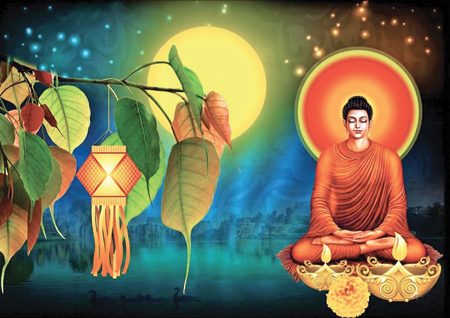 Giving away a certain portion of what one has rightfully earned with purity in
mind and full of happiness is called generosity. One might think, “What should
one give away any portion of what one has rightfully earned”? When qualities
like mutual respect, trust, compassion, equanimity and patience develop among
humans, the relationship and the value of generosity become more obvious. There
are four things that are common to all beings, namely food, sleep, fear and
reproduction of the species, but human beings are distinct because of the
ability of advanced thinking. Buddhism sees this ability as the basis for
generosity and morality. However, one shall not become generous in anticipation
of returns such as fame, praise, leadership or any other gain. One has to
develop generosity with a pure mind. Giving away a certain portion of what one has rightfully earned with purity in
mind and full of happiness is called generosity. One might think, “What should
one give away any portion of what one has rightfully earned”? When qualities
like mutual respect, trust, compassion, equanimity and patience develop among
humans, the relationship and the value of generosity become more obvious. There
are four things that are common to all beings, namely food, sleep, fear and
reproduction of the species, but human beings are distinct because of the
ability of advanced thinking. Buddhism sees this ability as the basis for
generosity and morality. However, one shall not become generous in anticipation
of returns such as fame, praise, leadership or any other gain. One has to
develop generosity with a pure mind.
Morality is the discipline of speech and body whereby one’s thoughts, words and
actions are harmless to one-self and to others. Can you imagine how much relief
it brings to all beings? There is no age difference in maintaining morality that
brings personal satisfaction and enhances the development of self confidence.
Sila is two-fold in which engaging in daily activities in a righteous and a
civilized way is described as AbhisamacharikaSila and the non-civilized and
anti-social way of life that cannot maintain morality as AbhibrahmacharikaSila.
Meditation is training of the mind. In the Pali Cannon it reads “BhavanathiVaddhana”.
Mind wonders perpetually and entangles in intentions. The intentions may be
wholesome or unwholesome where wholesome intentions foster happiness and the
unwholesome ones destroy happiness. Therefore, focusing and keeping the trained
and disciplined mind on wholesome thoughts is the first step in meditation which
produces steady physical and mental happiness. By following in-depth mediation,
one is able to comprehend the true nature of life with all its interactions.
Then, one realizes that I, me and mine are nothing but concepts.
While reading this, you may think that this is simple knowledge.
It is incorrect to assume that there is no time to follow the Dhamma in the
current industrious and hectic social environment. One can explore how
individuals living in any society can create a peaceful, satisfying and
compassionate environment through Buddha’s teachings. According to Buddhism
compassion, kindness and patience promote happiness and harmony in life while
remorse, hatred, revenge and greed promote unhappiness and disharmony.
It is worthwhile to depict some examples of Buddhist Saints (Arahants) who
achieved permanent peace and happiness by following the Buddha’s teachings.
These are not super human, but noble qualities that can be developed by average
human beings. Stories such as Kisagothamie, Patachara, Punna and
Rajjumalamentioned in the literature are known to many Buddhists. It is a joy to
reflect on how Buddha helped and relieved those human beings who were engulfed
in sorrow and helplessness. It should not be difficult to imagine the state of
mind of a woman who lost her husband, two children and her parents at the same
time. Patachara was one such woman. While people threw stones at her assuming
that she was an outcast, Buddha helped her to find relief by calling her
“sister”. Those compassionate words brought relief to her at a time when she was
engulfed in unending sorrow. We often experience the scenarios where individuals
are made to suffer rather than helping them to find relief, happiness and peace.
There are numerous individuals with physical and mental agony caused by social
problems. Even though every one of them cannot be helped economically, helping
them with at least a kind word is a way of seeing the Buddha. That is the Real
Vesak. |



 පසළොස්වක
 අව
අටවක
අව
අටවක අමාවක
අමාවක පුර
අටවක
පුර
අටවක